On the warriors the world chose to admire, the women it chose not to see, and the legend that made both possible.
Somewhere in Kabul, a girl of nine is legally marriageable. Her silence, under a decree signed this year by Afghanistan’s supreme leader, constitutes consent. Her guardian arranges the contract. The law considers it valid.
This is the society the world spent four decades calling unconquerable.
The Afghan fighter occupies a singular place in the Western imagination: ferocious, eternal, the scourge of foreign ambition. The phrase attached to him crosses editorial pages like a benediction. Graveyard of empires. It has rhythm, age, the satisfying weight of received wisdom. What it has never accounted for is the graveyard that actually exists: the one being filled, steadily and legally, with Afghan women.
That mythology was not organic. It was manufactured, at scale, with a budget. When the Soviet Union invaded in 1979, the United States, Saudi Arabia, and Pakistan’s intelligence services built a pipeline that funneled an estimated $12 to $14 billion into the mujahideen over a decade. They chose which commanders to elevate, which factions to arm, which narrative to export. The fighters became symbols of Cold War resistance. Think-tank fellows invoked Kipling. Journalists filed dispatches that read more like folklore than reporting. The freedom being fought for was left unexamined, because examining it was not the point.
The Soviet withdrawal in 1989 cemented the legend. What it reflected was more complicated: a superpower in systemic collapse, an economy that could no longer absorb the costs, a general secretary in Moscow who understood Afghanistan was bleeding a country already hemorrhaging from within. Real costs were imposed on the Soviets. But strip the Stinger missiles, the ISI logistics chain, and the foreign billions from the equation and the story looks different. Legends omit that part by design.
The commanders celebrated in Western capitals spent the decade after the Soviet withdrawal shelling Kabul into rubble, killing hundreds of thousands of Afghan civilians in factional fighting that had nothing to do with foreign occupation. The heroic narrative went quiet during those years. A foreign villain had served the story. Internal carnage did not.
The Human Cost Ignored
When the Taliban returned to power in 2021, the commentariat reached again for the familiar metaphor. The graveyard had claimed another empire.
What followed demands a different kind of attention entirely.
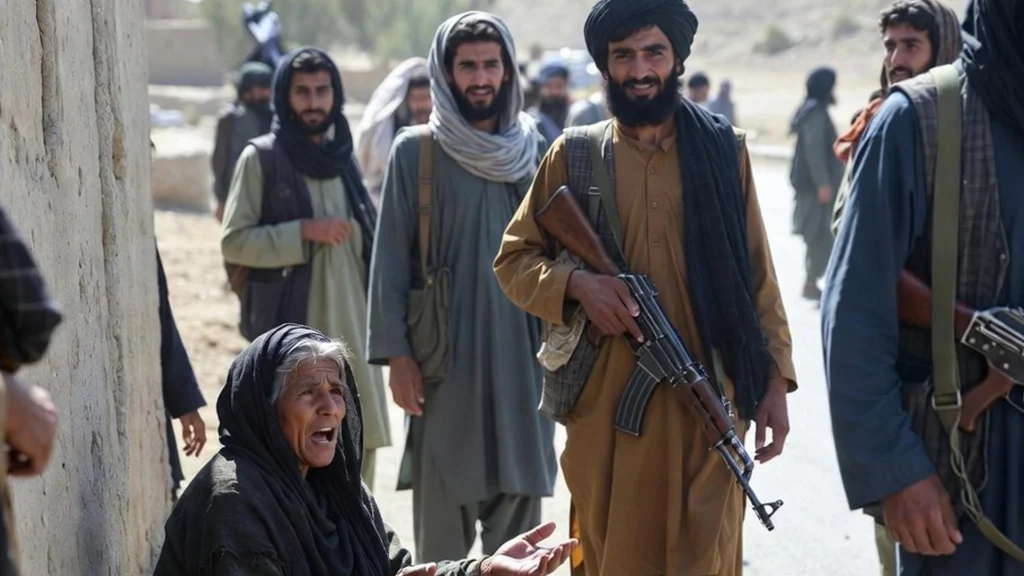
Within weeks, women were ordered home. Girls were barred from school, then university. The Ministry of Women’s Affairs was abolished and replaced with a Ministry for the Propagation of Virtue and the Prevention of Vice. By early 2026, a new criminal code permitted husbands to beat their wives provided the violence stopped short of broken bones or open wounds. Under that same code, the penalty for animal abuse outweighs that for a serious case of domestic violence. A woman fleeing that violence to her parents faces prosecution. So do the parents who take her in.
Approximately 80% of suicide attempts in Afghanistan are now by women, a reversal of global trends where men typically account for higher rates. Nearly 70% of Afghan women report anxiety, isolation, depression, and suicidal ideation. The authorities have barred health workers from publishing the statistics. The figures available are undercounts.
Maternal mortality, improving steadily for two decades, reversed after 2021. Midwives barred from their posts. Facilities shuttered. Women needing a male escort to reach medical care often arrived too late. Tens of thousands of deaths, projected across the years since the takeover, are deaths that did not have to happen.
Then the marriage decree. The minimum age of sixteen, already widely ignored in practice, was removed. Eligibility tied to puberty. A girl’s silence is now legal consent.
She can be nine years old.
The Afghan people carry none of this. Afghan women who have taught in secret, crossed borders to keep studying, documented their own erasure at personal risk, are its victims. The distinction between a people and the movement ruling them is clear. Retiring the mythology that movement benefits from has proved harder.
Battlefield endurance says nothing about whether a cause was just. History is full of peoples who fought with genuine tenacity for arrangements catastrophic for those living under them. What emerges when the fighting stops, what laws get written, whose silence gets called consent: those are the measures that matter.
A Different Path
The Kurds offer an instructive parallel, without romanticism.
Stateless, scattered across Turkey, Iraq, Syria, and Iran, they have fought for decades under active persecution, armed and abandoned by foreign powers who found them useful and then inconvenient. Kurdish fighters played a central role in breaking the Islamic State in Syria and Iraq at enormous human cost, in operations Western governments supported tactically while refusing any lasting political commitment.
They also built something while fighting. The women’s protection units, the YPJ, became one of the most significant military formations of the Syrian conflict. Women hold governance positions under a system mandating a minimum 40% female representation. The stated principle is direct: the revolution cannot be made for women but must be made by them.
Caveats matter here. The PKK, to which the YPJ is linked, is designated a terrorist organisation by Turkey, the United States, and the European Union. Rojava’s political structures are imperfect and operate under the pressure of ongoing war. Nothing here endorses Kurdish political movements or their methods.
What it does show is that decades of war, statelessness, and foreign interference do not make misogyny inevitable. A society fighting for survival can choose, deliberately, to bring women with it. That choice is available. It has been made elsewhere. Afghanistan’s current rulers have made a different one, with increasing legal precision and no apparent hesitation.
Time for Reckoning
The myth endures because it is emotionally satisfying. Foreign hubris, mountain defiance, imperial retreat. Clean shape. Easy moral. No difficult questions attached.
It does not ask about the girl whose silence became consent. It says nothing about the woman who cannot reach a hospital, or the one who decided dying was better than what remained of living.
Four decades of financing, romanticizing, and negotiating with jihadi movements across Afghanistan produced the legal architecture now governing Afghan women. The men who built that pipeline have not been asked to account for it. The women inside it have not stopped being required to endure it.
If Afghanistan is a graveyard, the empires buried there left under their own steam.
The women did not. ■