
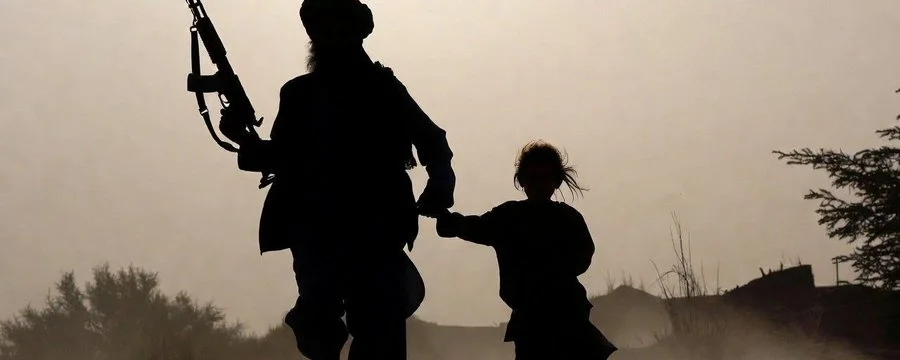
The new family code, the burning girls, and the silence the regime depends on.
Their names are Khoshbakht, Saliha, Fawzia, Benazir, Farzana, and Nazia. They are between six and ten years old. They live in Shahrak-e-Sabz, a settlement of mud-brick houses and tents for the displaced, on the outskirts of Herat city. Their parents sold them. In the same settlement, on the same visit, the researchers from the United States Institute of Peace counted one hundred and eighteen girls who had already been sold, and one hundred and sixteen families with girls still waiting for buyers. The total was forty percent of the families surveyed. The report was published in the Washington Post in January last year. The girls have not been written about since.
This week, in Kabul, the Islamic Emirate’s Ministry of Justice published its new family code. Thirty-one articles, personally approved by the Taliban’s supreme leader, Hibatullah Akhundzada. The regulation is called Principles of Separation Between Spouses. It writes into law what was already being done to Khoshbakht, Saliha, Fawzia, Benazir, Farzana, and Nazia, and to most of the girls in most of the villages where the regime now governs.
What the new code permits
Article five recognises the marriage of a child as legally valid, provided the dowry is appropriate. Article seven rules that the silence of a girl who has reached puberty constitutes her consent to the marriage.
Afghan law has had no minimum age of marriage since August 2021. The Republican code, which set it at sixteen for girls and eighteen for boys, was discarded along with the rest of the system that produced it. A man may now marry a girl who has just had her first menstruation, beat her under article thirty-two without serious consequence, and have her silence read as her assent. The code formalises this in plain language.
What puberty actually means
The Taliban’s Ministry of Promotion of Virtue and Prevention of Vice has previously stated that a girl may be given in marriage once she reaches puberty. The first signs of puberty in girls appear from around the age of nine. First menstruation, in most girls, occurs between ten and thirteen.
A young girl who has begun to menstruate is still a child whose body is years from being grown.
She is also a child whose mind is years from being formed. The human brain continues developing into the mid-twenties. The prefrontal cortex, which governs judgement, risk assessment, and the capacity to weigh consequences against pressure, is among the last regions to mature. A twelve-year-old, a fourteen-year-old, a fifteen-year-old cannot weigh the decision to enter a marriage, cannot weigh the decision to consent to sex, cannot meaningfully resist an adult man backed by clerical authority, a father, and a village. She does not yet possess the equipment that those decisions require. Every paediatric, legal, and medical body on earth accepts this, including across the Muslim world. It is why every functioning legal system distinguishes the child from the adult, and why no working jurisdiction permits a child to sign a contract, give full testimony, or consent to medical treatment without a guardian. Informed consent depends on faculties a child does not yet have.
Compliance, in the regime’s vocabulary, has been written down as her assent. Article seven is the legal fiction by which the rape of a child appears on the page as her marriage.
The consequences are visible in the hospital data. A girl between ten and fourteen is five to seven times more likely to die in childbirth than a woman in her twenties. A girl between fifteen and nineteen is twice as likely. Infant mortality is sixty percent higher when the mother is under eighteen. The medical risks include obstetric fistula, eclampsia, puerperal sepsis, prolonged obstructed labour, and haemorrhage. In Badakhshan province, where more than forty percent of girls in some districts are married before fifteen, prolonged obstructed labour accounts for one in three maternal deaths.
Afghanistan has the eighth-highest maternal mortality rate in the world. Six hundred and thirty-eight women die for every hundred thousand live births. The adolescent pregnancy rate is seven hundred and eleven per thousand. The girls dying in those numbers are the girls the regime has now signed the law for.
Eighty percent
Eighty percent of suicide attempts in Afghanistan are by women. Ninety-five percent of self-immolation victims are girls between fourteen and nineteen. Every other country on earth records the opposite pattern, with men taking their own lives more often than women, sometimes twice as often. Afghanistan has reversed the global figure, and the reversal has deepened since August 2021.
Hospitals in Herat reported a fifty percent rise in female patients within months of the takeover. The Fuller Project’s 2023 investigation found that in nine of the eleven Afghan provinces it sampled, more women than men were attempting suicide. The most common methods are rat poison, hanging, and self-immolation. The most common ages are fourteen, fifteen, sixteen.
In February last year, in Khakrez district of Kandahar, a young girl ingested poison and died in hospital the same night, days after her family had given her in marriage to a man over fifty in exchange for a large sum of money. Her name was not released. In Baghlan, in the Deh Salah district, a seventeen-year-old who had been married off to a thirty-seven-year-old man four months earlier killed herself after several previous attempts. Two weeks later in Faryab, another girl took her own life after strongly opposing a marriage her father had approved. The pattern is documented across the country in cases that rarely reach the wire. The names are mostly withheld. The funerals are quiet. The next marriage is already being arranged.
What the regime has not banned
The regime has banned women from universities, from secondary school, from working in non-governmental organisations, from working as midwives in a country with the world’s worst maternal mortality, from travelling more than seventy-two kilometres without a male relative. The streets of Kabul remain available.
You can see them at the intersections, in chadari, holding small children, holding out cupped hands.
The Taliban have built a public morality around the protection of Afghan women. The visible reality of the capital is that the women have been driven from clinics and classrooms to traffic islands. The dignity argument, repeated to every visiting diplomat, falls apart at the first roundabout.
There were two hundred and seventy female judges in Afghanistan in August 2021. They were dismissed by the end of the year, and many fled abroad fearing reprisals from the convicted men they had previously sentenced. Thousands of female teachers, doctors, lawyers, and civil servants were sent home, in some cases replaced by male relatives, in most cases erased from the payroll. The midwifery and nursing training programmes were shut down in December 2024.
Afghanistan now produces no new female medical workers, in a country where female patients cannot be examined by male doctors. Maternal mortality is rising. Child mortality is rising. Malnutrition among children under five is among the worst in Asia. The girls denied education today are the doctors, judges, engineers, and mothers Afghanistan will not have in twenty years.
The structural fact behind these decisions is settled in the development literature. No country that suppresses half its population progresses. The World Bank, the IMF, the UNDP, and forty years of consensus research confirm it. Afghanistan is becoming unviable in slow motion, in front of an audience that has chosen to look away.
What the regime won’t criminalize
The same regime has produced a thirty-one-article code on the separation of spouses, detailed regulations on the silence of girls and the beating of wives, and a public morality built on the protection of male virtue. It has produced no enforcement action against the practice of bacha bazi.
Bacha bazi, literally “boy play,” is the keeping of pre-pubescent and adolescent boys, often dressed in women’s clothing, for the entertainment and sexual use of older men. It has a long history in Afghanistan, was criminalised under the 2017 penal code, and has been theoretically banned by every regime including the current one. The 2025 United States Trafficking in Persons Report, published in September last year, found that bacha bazi continues to be documented among Taliban officials and across nearly all armed factions in the country. For the third consecutive year, the regime reported zero investigations, zero prosecutions, and zero convictions of its own members.
Survivors have told human rights monitors that local commanders and elites are now the principal perpetrators. Boys are sourced from impoverished families, from displaced households, from the street. The 2025 report also documents Taliban detention facilities holding child trafficking victims alongside adult prisoners, where they are subjected to sexual abuse, forced labour, and torture. Videos circulate on TikTok and Telegram, posted by Taliban fighters themselves, of young boys in makeup and women’s clothing, in postures the regime would never permit a woman to be photographed in.
A movement that built its public morality on the removal of women is, in its own ranks, abusing the children of the other sex. The men who insist that women must be hidden to preserve male virtue have, in three years, produced no enforcement record of any kind on the abuse of boys. The architecture of the moral claim collapses on contact with the moral practice.
What the regime inherited
The regime did not invent the cruelty.
Forced marriage, walwar and bride price, badal and baad, the exchange of girls to settle blood debts and family disputes, the cousin networks that turn a girl’s refusal into a family dishonour, the village hierarchies that punish her if she runs, all of this predates the Taliban, the Republic, and the Soviet war. The Republican government, with all its imperfections, criminalised the worst of them, set a minimum marriage age, opened the schools, allowed female judges to sit, and allowed the radio stations to broadcast women’s voices. The progress was fragile, slow, and uneven, and it was real.
The Taliban have taken the cruelty Afghanistan already had and signed for it. They have inherited the worst of the custom and made it law. The bride price that was once paid in private has now been formalised in article five of the new code. The silence that was once mistaken for consent has now been written into article seven. The beatings that once happened behind walls have now been permitted, with conditions, in article thirty-two.
The change is in the legal architecture. In some districts, on some days, that architecture had once stood between an Afghan girl and the people who wanted to harm her. The architecture is now gone.
The silence
Foreign delegations to Kabul are not in short supply. The trade missions arrive. The mineral contracts are signed. The diplomatic recognitions accumulate, one country at a time. The discussions cover transit corridors, border security, counter-terrorism cooperation, and refugee returns. Khoshbakht and Saliha do not appear in the discussions. Neither do the burnt girls of Herat’s wards, the girl in Khakrez who swallowed the poison, or the boys whose families do not file the cases.
The regime depends on this silence the way the new family code depends on article seven. The girls have been silenced into the appearance of consent. The world has gone quiet for its own reasons, and the regime banks the quiet as legitimacy.
Khoshbakht is one girl in a country full of daughters whose names will not appear in another report. The new code does not require her to be named. The diplomatic schedules do not require her to be mentioned. The least the rest of us can do is name what the regime has written down, and ask the next foreign minister flying into Kabul what he raised, and what he did not.
The money the families in Shahrak-e-Sabz took for their daughters has long since been spent. The law that wrote what would happen to those daughters has just been published in the gazette.